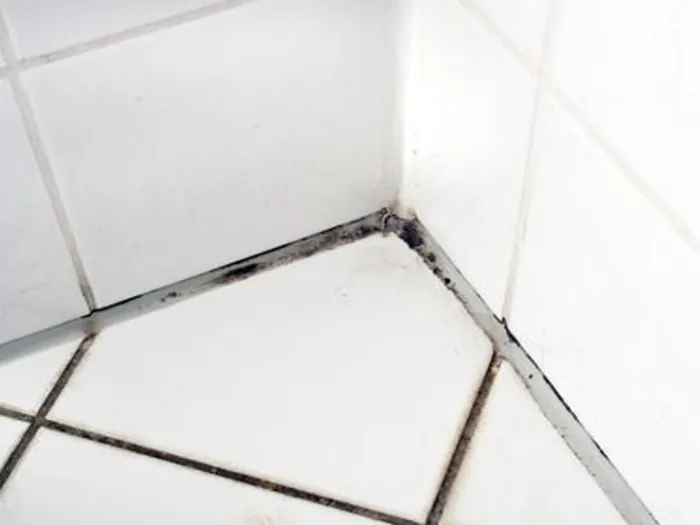
Mould develops in areas exposed to continuous moisture and humid conditions, such as around baths and shower trays. Mould growth is accelerated by numerous factors, including poor ventilation and surface temperature. Silicones are excellent insulators and are often the warmest surface for mould to develop. Mould therefore appears along sealant joints in the form of black spots or discolouration. Not all fungi appear as black spots, however most of them do.
Often the presence of mould can be a reoccuring event. The microscopic spores arrive on a sealant joint, the spores then start to absorb moisture and swell. The spores grow into a germ tissue, mycelium, and very quickly develop into visible mould. To begin with, the growth of the mould fungus is limited to the organic waste materials on the sealant surface, known as primary mould growth. This highlights the importance of regular cleaning, regardless of whether an anti-mould silicone sealant is used.
CAUSES LEADING TO MOULD GROWTH
The environmental conditions prone to mould growth are commonly associated with bathrooms and kitchens. Factors with the highest influence on recurring mould include:
High moisture content and humidity
Poor air circulation and ventilation
Organic waste materials on the sealant surface (such as soap, body gel, kitchen garbage etc.)
Warm surface temperatures
Unlevel sanitary installations (e.g. baths and sinks) that prevent water run-off
PREVENTION AGAINST MOULD
It should be mentioned that good hygiene of the sealant surface will prevent the formation of this kind of contamination. Regular cleaning and disinfecting of the surfaces will keep the sealant, and all other materials in that area, free from mould.
It is impossible to prevent the presence of fungi spores in the surroundings. However, in an environment that is regularly aerated and that is kept dry, the anti-mould performance of sanitary sealants is much stronger. In addition, the joint surfaces need to be cleaned regularly with a neutral cleaner and disinfected regularly with a germ-killing disinfectant.
MOLD INHIBITORS (FUNGICIDES)
Specific sealants have been developed to block the formation of microscopic spores into mould fungus. Adding mould inhibitors, named fungicides, to these sealants initiates a process that will consume the scopes and prevent mould growth for as long as possible. The amount of fungicide in the cured sealant decreases gradually over time. After some time, the total amount of fungicide is in the sealants will deplete, meaning mould may form again on the surface of the sealant. A sealant surface containing mould inhibitors will therefore remain mould-free for a longer time than a non-fungicide sealant.